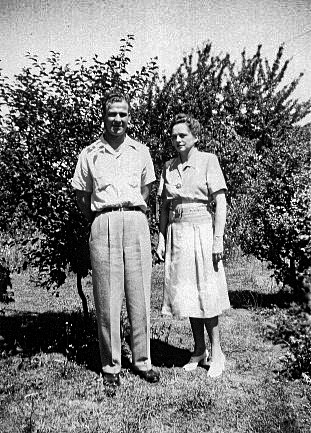
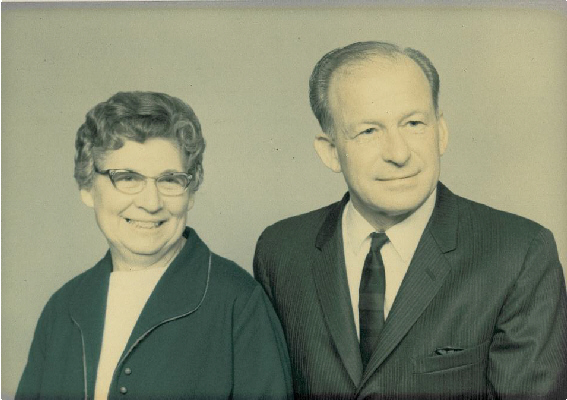
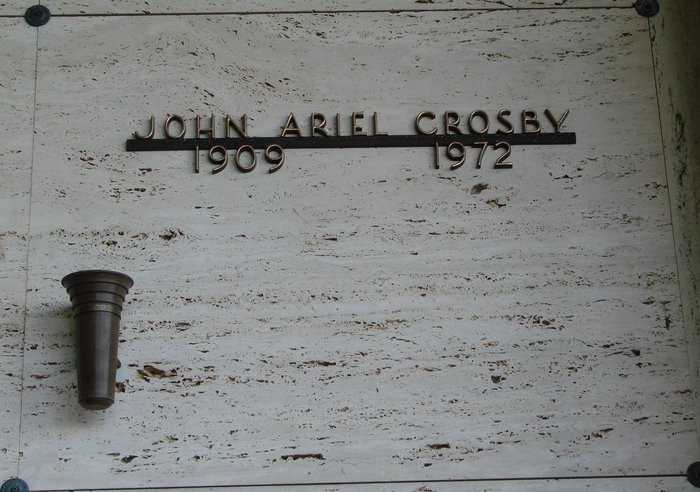
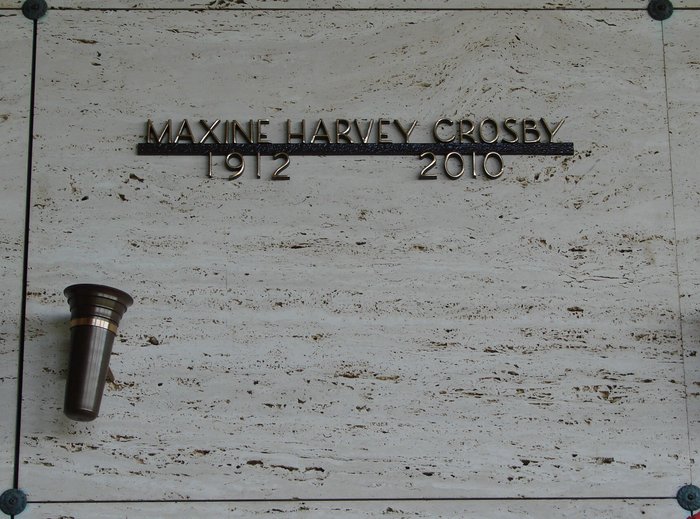
Paul Harvey Crosby, sixth and youngest child of John Ariel Crosby and Maxine Virginia Harvey Crosby, wrote this account of their branch. He is a 9th great-grandson of Simon Crosby. Most of the story took place in the 1900s.
His Crosby grandparents were Clarence Wallace Crosby and Teresa Levice Day Crosby. The Harvey grandparents were Lelburn Curtis Harvey and Mabel Catherine Wood Harvey. They lived in and near Glen Ellyn, Illinois, in the first 30 years of the 1900s.
Ariel first lived in Zion, later Glen Ellyn. For about five years, from about age two to seven, he lived with his parents and siblings in and near Bartle, Cuba. His mother and sister died of malaria in 1916 and 1917. They are buried, presumably, in or near Bartle. Soon after, Clarence fled Cuba with his six sons because of the 1917 revolution. They returned to Zion.
Ariel and Maxine met at a friend’s birthday party in Glen Ellyn about 1925. He was 15. She was 12. “He was at my house the next day,” she told Paul. They dated others for a time. They married on November 6, 1931, in a small wedding in a Tudor house in Glen Ellyn.
They had six children. Julia Day was born in 1932 and John Ariel, Jr., in 1935. Each died in infancy of a disease involving a thin and perforated intestine. Julia Day lived about a year. John Ariel, Jr., a few months. Nancy Virginia was born in 1933 and died in 1994, at 60, of a stroke. Paul was born in 1950. Two other children lived to adulthood. The old page left those two names off, as “Living.” That choice stays. Paul never married and had no children. Nancy’s four children and the others’ grandchildren are not listed here.
They married young, in the Depression. The family, and Maxine’s brother and sister-in-law, lived with the Harvey grandparents in Glen Ellyn. Only the grandmother had an income. She was a Christian Science practitioner. The rest were unemployed. The grandparents bought an inn in northern Wisconsin for a bed-and-breakfast. Tourists came only in summer. In winter there was no business.
Ariel told the others he would walk out of the wilderness until he found a job. He did. He landed a filling-station job in Eau Claire, Wisconsin. He and Maxine wrote. In the spring he brought her to Eau Claire. He worked 12 hours or more a day and earned about $20 a month, with a half day on Sundays.
The family later returned to Glen Ellyn. Ariel worked for Sears Roebuck in Chicago and built a house for his branch with his own hands. In World War II he was exempt — married, with three children — and was assigned as a final inspector in a warplane plant in Chicago, then at Electromotive, making locomotives.
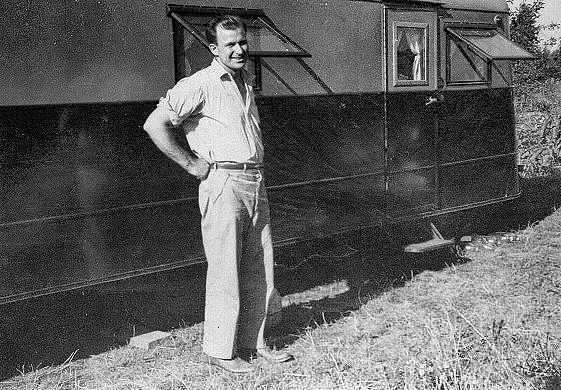
Maxine and Ariel did not want to raise children in that large city. Uncle David and Aunt Eleanor had settled in Portland after the war and asked them to come west. In 1947 the family — except Paul, not yet born — hauled a long trailer across the country. They stopped at Uncle George and Minnie on the wheat farm near Hardin, Montana. Paul later wrote that George’s family were content in conditions most people would have called primitive: outhouse, well, heat and cold, little insulation, no air conditioning, a barren landscape.
In Oregon the parents wanted different lives. Ariel wanted to homestead, unimproved land west of Portland, still living in the trailer — “to want more was to be weak of spirit.” Maxine wanted a small farm east of Portland with ordinary 1947 comforts. They took her choice. He was never really happy with it. He wanted something more from scratch, more “Crosby.” He believed he had the genius to invent, like his father and his brother Steven, if the family had faith in him.
Paul was born in 1950. They left the farm in 1953. He has almost no memory of the unhappiness of those years. His mother, brother, and sisters carried wounds: boredom, isolation, hard work, a house without modern comforts. Ariel later told Maxine his heart was not in the farm. He had paid only interest on the mortgage, nothing on the principal. He had never wanted to own it.
He raised chickens and made a feed good enough that a Salem restaurant sought a contract. He was proud of his Chewing’s Fescue grass. The grass made Maxine deathly ill with asthma. Both had been taught that doctors and medicine were evil. When she lay gasping, he waited. A nearby doctor said get her away from the grass or prepare to bury her. She and Paul stayed with David and Eleanor in Portland until the pollen was gone.
Ariel left farming for a neighbor’s ceramic drainage-tile plant, then a brick and tile plant in Forest Grove. He made a better tile and brought the plant back from collapse. The local paper put him on the front page. The owner sold. Two co-workers fired him and used his formula. The business went broke soon after.
In 1957 he was 47 — then thought too old for good work. He was under-employed for three years. They were desperately poor. Many moves. By age 10 Paul had attended eight schools. They lived for a time with Nancy in Portland, parents in the attic.
Then the State of Oregon asked him to interview, based on work running the power plant at Wheaton College years before. The job in Salem was to keep power — and the cell-block doors — at the state penitentiary. Maxine persuaded him to go. In January 1960 they moved to Salem. Paul entered fourth grade at Richmond School mid-year and, for the first time, stayed a whole year in fifth. Ariel’s state job gave him room to invent. He died November 27, 1972, in Salem, at 62. Maxine lived until April 22, 2010, at 97. She never remarried.